November 17, 2026
In controlled environments, iProov has successfully enabled AI agents to use many of the same tools, sessions, and credentials that people have traditionally used to exercise authority. This creates a new problem for approval systems. Evidence that a valid authentication factor was used, such as a password, one-time code, or email verification, does not necessarily prove that the authorized person intended to approve the specific action. An agent may hold, use, or replay conventional credentials, and in severe cases of prompt injection, it may even satisfy the apparent conditions of its own authorization. But requiring human approval for every tool call defeats much of the purpose and efficiencies that make agentic AI valuable.
The central challenge is to strike a balance between autonomy and controlled accountability. Agents need standing authority to complete long sequences of work, but some decisions must be provably human and recorded for audit. This raises two questions:
- When must human authority override an AI agent?
- What evidence can establish that authority when the agent may already control the credentials, tools, and channels normally used for approval?
Distinguishing Possession from Intent
Conventional digital approval often treats possession as a proxy for intent on the basis that if someone can use the required credential, the system assumes that they intend to approve the action. AI agents weaken this inference because credentials may have been deliberately delegated to them; an agent may lawfully hold a person’s session, credentials and tools, or it may gain access to them unlawfully. The resulting evidence can therefore be technically valid but still fail to show that the correct human saw, understood, and authorized that action.
An agent may also retain a factor used for one purpose and replay it in another, detaching the approval from the transaction that prompted it. This risk applies to second channel factors of authentication such as SMS. Sending a code from a desktop session to a mobile phone once provided security because control of one device did not usually provide control of the other. However, given the risk that an agent could, in cases of prompt injection or severe miscomprehension, recruit another agent on that device to retrieve the message and complete the process on the first device, this principle is undermined even without a breach of either device’s conventional security controls.
For routine, low-consequence actions, this remaining uncertainty may be acceptable because the risk of rare circumvention is outweighed by the efficiency gains and business value given the limited and reversible repercussions. It is not sufficient, however, for an irreversible transaction, a legally binding submission, or a decision that creates or extends the agent’s authority. Beyond this threshold, proof of access must be replaced with proof, and a durable record, of human intervention.
Agent-Resistant Proofs
An agent-resistant proof is evidence that the agent cannot produce by using the systems available to it. Its purpose is not to obstruct work already entrusted to the agent, but to protect the few decisions that determine the existence, scope, or exceptional use of its authority.
The most stable way to ensure this is to require evidence that originates outside any agent’s operating context. Given that placing an approval on another device, runtime, or cloud environment is insufficient if another agent can retrieve, use, or simulate it, the strongest proof begins beyond the digital systems an agent can operate in. It might require a deliberate human action using secure hardware, a physical key, or a biometric check that establishes liveness at the time of capture. Even if an agent may open the approval interface, relay a challenge or observe the process, it cannot create or replace the human action on which approval depends.
Where possible, the approval request and response should also go through a separate channel. Even genuine human evidence is insufficient if the agent controls how it describes the proposed action. The control system should present the action directly to the approver, using authoritative details taken from the action itself rather than a summary written by the agent. This prevents a compromised or misaligned agent from hiding important information, understating the consequences, or describing a different, more acceptable action.
The decision should then return directly from the approval interface to the requesting system. The approval record must bind the identified person to the exact decision as presented: the affected resources, systems, or counterparties; the changes to be made; the applicable limits; the expected outcome; and the expiry of the authority. Without this binding, even strong human-originating proofs become reusable tokens that may be transferred to another transaction or presented as evidence of agreement to an action the person never saw.
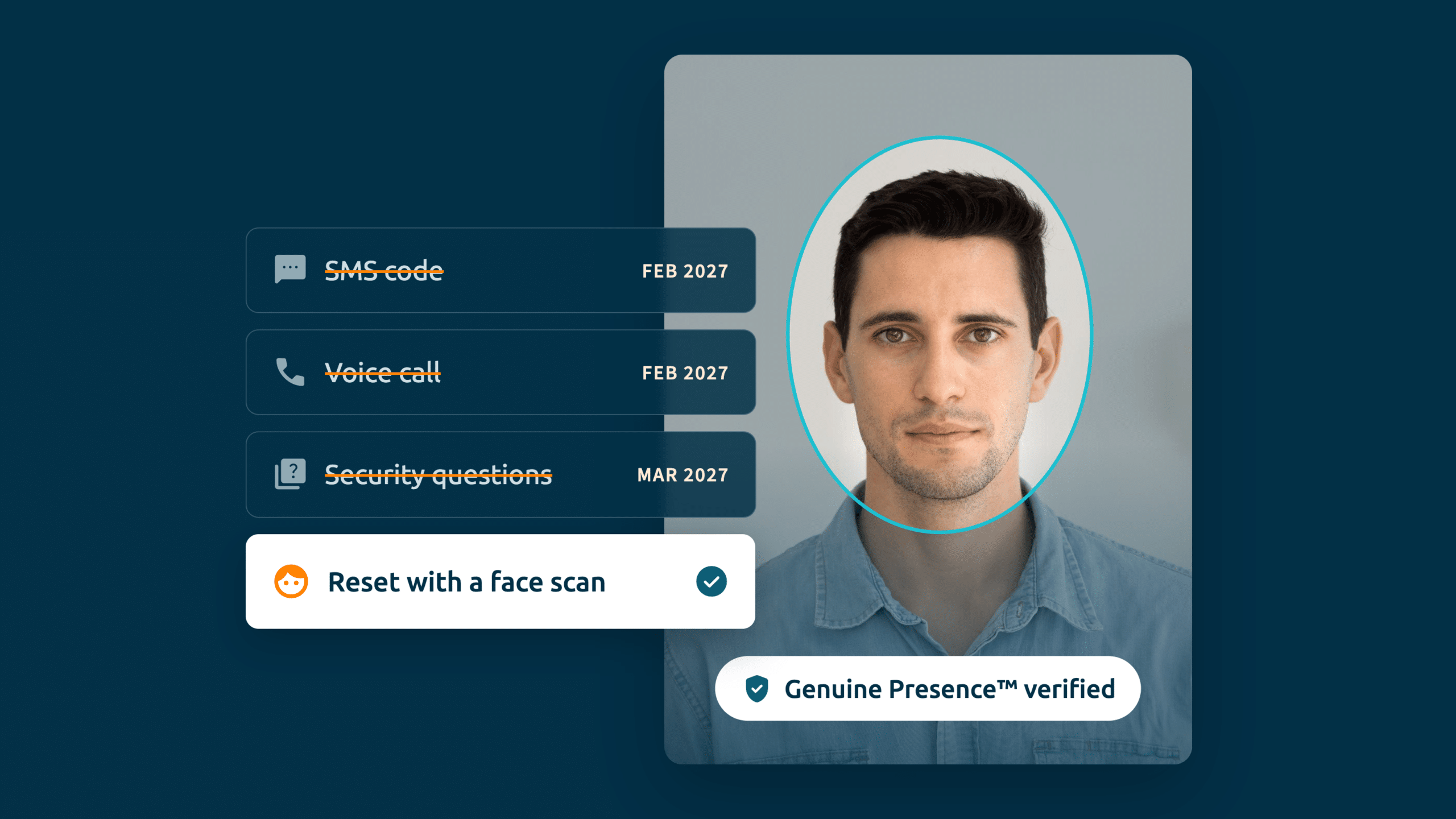
At iProov, we see liveness-backed biometric verification as one way to provide this human-originating evidence. Its value lies in establishing the named person’s presence at the time of approval, rather than merely showing that a reusable digital factor was available. Liveness does not prove intent by itself. Combined with authoritative action details and a direct return path, however, it can help establish that the correct person approved the specific decision presented to them.
Appendix
| Factor | How an agent may satisfy it |
| Passwords, PINs and security answers | Retrieve them from memory, a password manager, secrets vault, browser or accessible file. |
| Session cookies and authenticated sessions | Act through a session already established by the human. |
| API keys, OAuth tokens and workload credentials | Present credentials that have legitimately been delegated to the agent or its runtime. |
| Email, SMS and TOTP codes | Read the relevant inbox, messaging application or authenticator output, either directly or through a recruited agent. |
| Magic links | Open the link through an accessible browser or email client. |
| Push approvals and number matching | Operate the approval interface when it controls the device, or recruit an agent that does. Resolved through secure enclaving. |
| Device-bound credentials | Invoke them where control of the device or operating-system interface is sufficient. Device binding does not necessarily imply human involvement. |
| Passkeys | Invoke the platform authenticator where the agent can operate the authorised device and satisfy the configured user-verification ceremony. Resolved through secure enclaving, and / or the use of device based biometrics. |
| Rudimentary presence checks | Supply prerecorded, synthetic or otherwise mediated input where the check does not establish genuine liveness at capture. |
| Click-through approval screens | Select “approve”, “confirm” or an equivalent response where the interface is accessible. Resolved through secure enclaving. |
| Reusable approval assertions | Replay or redirect a valid assertion if it is not single-use and cryptographically bound to the exact action. |