
Zertifizierungen
Zertifizierungen
iProov nimmt die Einhaltung von Vorschriften sehr ernst und erfüllt eine Vielzahl von Branchenstandards.
FIDO-Allianz
iProov Dynamische Lebendigkeit® ist das die weltweit erste FIDO-zertifizierte Lösung für die Fern-Gesichtsverifizierung,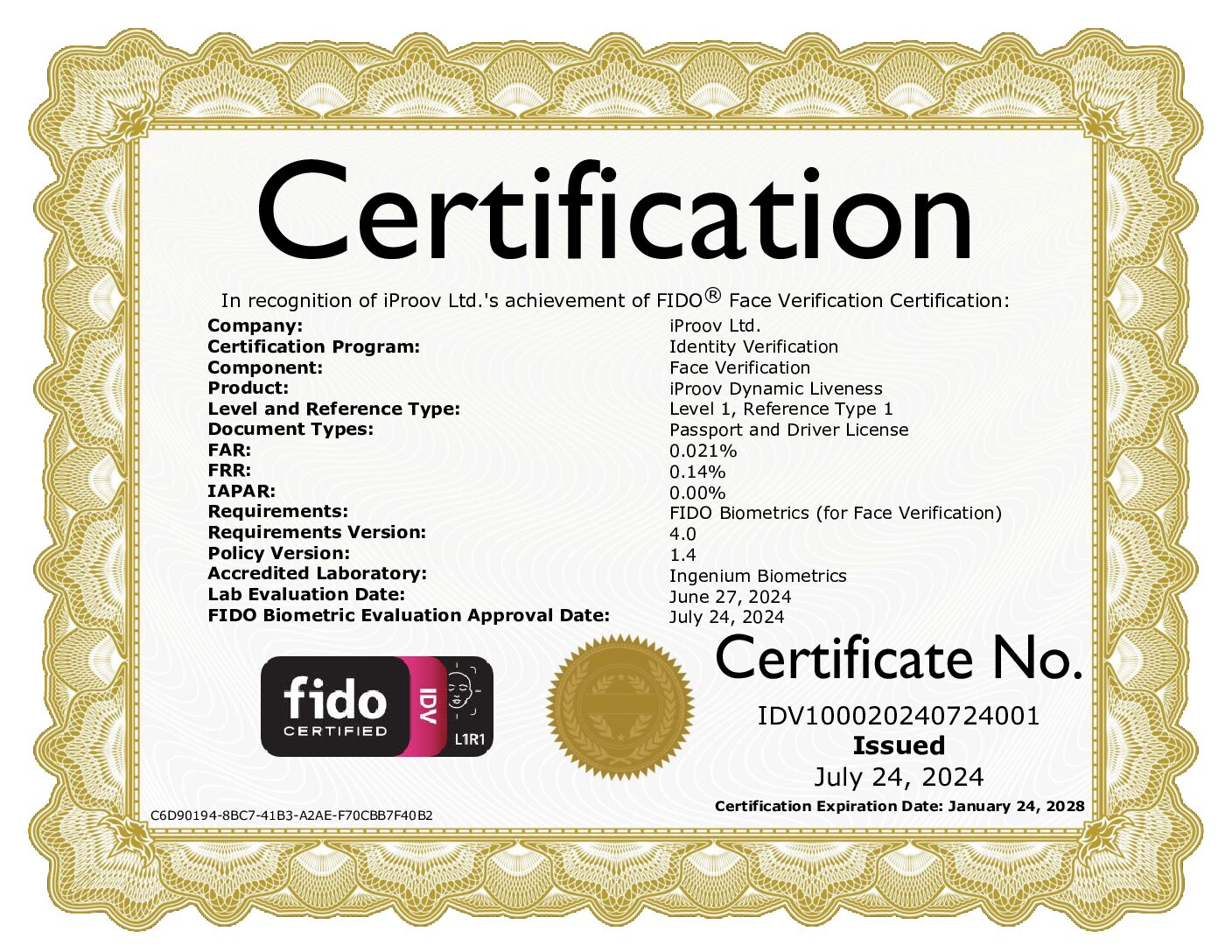 von Ingenium Biometrics akkreditiert.
Was ist die FIDO-Zertifizierung für die Gesichtserkennung?
Die FIDO-Zertifizierung für die Gesichtserkennung ist das strengste Bewertungsprogramm, das die Zuverlässigkeit, Benutzerfreundlichkeit und Sicherheit der Identitätsprüfung aus der Ferne Systeme zur Identitätsüberprüfung .
Warum ist die FIDO-Gesichtsverifizierung so wichtig?
Dynamic Liveness wurde einer umfassenden Bewertung seiner Funktionen zur Gesichtsabgleichung und Lebendigkeitserkennung gemäß den Normen ISO 19795 und ISO 30107 unterzogen. Die Technologie blockierte jede Art von Präsentationsangriff, wie Fotos, Masken, Gesichtsverzerrungen, Videos und vorgelegte Deepfakes, erfolgreich.
Die FIDO-Zertifizierung bestätigt die Robustheit der Lösung und unterstreicht ihren beispiellosen Schutz vor sich ständig weiterentwickelnden Bedrohungen über den gesamten Identitätslebenszyklus hinweg. Sie setzt einen Qualitätsstandard und unterstreicht die Fähigkeit der Anbieter, Verbraucher vor Präsentationsangriffen und vorgelegten Deepfakes zu schützen, indem sie proprietäre Angaben zur Angriffsabwehr durch unabhängig verifizierte Leistungskennzahlen für die Imposter Attack Presentation Match Rate (IAPMR) und die False Rejection Rate (FRR) ersetzt.
iBeta
ISO 30107-3 geprüft von iBeta
Die „Dynamic Liveness“- und „Express Liveness®“-Technologie von iProov entspricht der Norm ISO/IEC 30107-3:2017 für die Prüfung der Stufen 1 und 2 der Presentation Attack Detection (PAD).
Was ist eine iBeta-Prüfung nach ISO/IEC 30107-3?
iBeta ist ein vom NIST NVLAP akkreditiertes Prüflabor für Biometrie (NVLAP-Prüflabornummer 200962-0). Die iBeta-Qualitätssicherung führte PAD-Prüfungen gemäß ISO/IEC 30107-3 durch. ISO/IEC 30107-3:2017 legt Folgendes fest:
- Grundsätze und Methoden zur Leistungsbewertung von Mechanismen zur Erkennung von Präsentationsangriffen;
- Berichterstattung über die Testergebnisse aus der Bewertung von Mechanismen zur Erkennung von Präsentationsangriffen;
- Klassifizierung der bekannten Angriffsarten
Warum ist die iBeta-Zertifizierung wichtig?
iBeta führt seit 2012 als unabhängiges externes Labor biometrische Tests durch. Bei der Prüfung der Technologie von iProov gelang es iBeta nicht, mit Presentation Attacks (PA) unbefugten Zugriff zu erlangen, was zu einer PA-Erfolgsrate von insgesamt 0 % führte, was einer kombinierten Imposter Attack Presentation Match Rate (IAMPR) von 0 % entspricht. Dies liefert einen als Benchmark dienenden, auditierbaren Nachweis dafür, dass das System echte Benutzer von hochwertigen Fotos, Videos und Masken unterscheiden kann. Unabhängige Tests untermauern die Sicherheit der iProov-Sicherheitslösungen.
ISO/IEC 19795-1:2006
Die iProov-Technologie entspricht der Norm ISO/IEC 19795-1:2006 und wird vom britischen National Physical Laboratory (NPL) geprüft.
Was ist ISO/IEC 19795-1:2006?
Das NPL entwickelt und verbessert Methoden zur Bewertung der Leistungsfähigkeit biometrischer Systeme und führt Bewertungen sowie technische Beratungen zur Leistungsfähigkeit biometrischer Systeme durch, um eine robustere und genauere Erkennung zu erreichen. Die Methodik von iProov zur Prüfung der Leistungsfähigkeit biometrischer Verifizierung entspricht den relevanten Anforderungen der Norm ISO/IEC 19795-1:2006, und diese Methoden zur Prüfung der Erkennung von Präsentationsangriffen entsprechen der Norm ISO/IEC 30107-3:2017.
Was bedeutet die Konformität mit ISO/IEC 19795-1:2006?
Diese Zertifizierung bestätigt, dass die Grundsätze und Methoden von iProov die Wirksamkeit seiner Mechanismen gegen Präsentationsangriffe gewährleisten, die der Norm ISO/IEC 19795-1:2006 entsprechen.
ISO/IEC 19795-1:2006
Die iProov-Technologie entspricht der Norm ISO/IEC 19795-1:2006 und wird vom britischen National Physical Laboratory (NPL) geprüft.
Was ist ISO/IEC 19795-1:2006?
Das NPL entwickelt und verbessert Methoden zur Bewertung der Leistungsfähigkeit biometrischer Systeme und führt Bewertungen sowie technische Beratungen zur Leistungsfähigkeit biometrischer Systeme durch, um eine robustere und genauere Erkennung zu erreichen. Die Methodik von iProov zur Prüfung der Leistungsfähigkeit biometrischer Verifizierung entspricht den relevanten Anforderungen der Norm ISO/IEC 19795-1:2006, und diese Methoden zur Prüfung der Erkennung von Präsentationsangriffen entsprechen der Norm ISO/IEC 30107-3:2017.
Was bedeutet die Konformität mit ISO/IEC 19795-1:2006?
Diese Zertifizierung bestätigt, dass die Grundsätze und Methoden von iProov die Wirksamkeit seiner Mechanismen gegen Präsentationsangriffe gewährleisten, die mit ISO/IEC 19795-1:2006 konform sind.
Europäische GDPR (General Data Protection Regulation) (EU) 2016/679 & UK Data Protection Act 2018
Die Lösungen von iProov entsprechen den weltweit strengsten Datenschutzbestimmungen: der europäischen Datenschutz-Grundverordnung (DSGVO) (EU) 2016/679 und dem britischen Datenschutzgesetz von 2018.
Was sind die EU-DSGVO und das britische Datenschutzgesetz?
EU-DSGVO: Die Datenschutz-Grundverordnung ist eine Verordnung des EU-Rechts zum Datenschutz und zur Privatsphäre in der Europäischen Union und im Europäischen Wirtschaftsraum. Die DSGVO ist ein wichtiger Bestandteil des EU-Datenschutzrechts und der Menschenrechtsnormen, insbesondere von Artikel 8 der Charta der Grundrechte der Europäischen Union. Britisches Datenschutzgesetz: Das Datenschutzgesetz von 2018 regelt, wie Ihre personenbezogenen Daten von Organisationen, Unternehmen oder der Regierung verwendet werden. Das Datenschutzgesetz von 2018 ist die britische Umsetzung der Datenschutz-Grundverordnung (DSGVO).
Warum sind die DSGVO und die britischen Datenschutzbestimmungen so wichtig?
Die Einhaltung der DSGVOund der britischen Datenschutzbestimmungenunterstreicht die soliden Datenrichtlinien und -prozesse von iProov sowie ein tiefgreifendes Verständnis der Datenschutzvorschriften.
eIDAS
eIDAS EN 319-401 sowie modulare Zertifizierungen;elektronische Signaturen auf qualifizierter Ebene und eID-Sicherheit der Stufe „High“. Aufgrund der jährlichen eIDAS-Audits entspricht dies auch Artikel 24 Absatz 1 Buchstabe d der Geldwäscherichtlinie 5 (AMLD5). Für diese Anforderung ist unsere„Trust Service Practice Statement“öffentlich zugänglich.
Was ist eIDAS?
eIDAS (electronic IDentification, Authentication and trust Services) ist eine EU-Verordnung über elektronische Identifizierung und Vertrauensdienste für elektronische Transaktionen im europäischen Binnenmarkt. Die unabhängige Konformitätsbewertung erfolgt gemäß der Verordnung (EU) Nr. 910/2014 in der durch die Verordnung (EU) Nr. 2024/1183 (eIDAS 2) geänderten Fassung, mit der der Rahmen fürdas European Digital Identity Wallet(EUDI Wallet) eingeführt wird.
Warum ist die eIDAS-Konformität wichtig?
Die auf iProov basierenden Lösungen entsprechen den Normen ETSI EN 319 401 und ETSI EN 319 411-1/2 und wurden von unabhängigen Prüfstellen, darunter die TÜV Austria CERT GmbH und Ernst & Young, hinsichtlich der Konformität mit Artikel 23 Buchstabe d der eIDAS-Richtlinie zertifiziert. Darüber hinaus wurde die modulare Zertifizierung von iProov für eSig auf dem Qualified-Level und für eID auf dem Assurance-Level „High“ geprüft. iProov entspricht zudem AMLD5 Artikel 24 (1) d. Diese strengen Prüfungen schaffen Vertrauen in die Zuverlässigkeit und Stärke der Lösungen, minimieren den betrieblichen Aufwand von Unternehmen durch separate Prüfprozesse und beschleunigen die Markteinführung.
ETSI TS 119 461
iProov entspricht der Norm ETSI TS 119 461 für die Fernidentitätsprüfung und erfüllt die technischen Anforderungen für die Erreichung eines „substanziellen“ und eines „hohen“ Sicherheitsniveaus (LoA) gemäß der Verordnung (EU) Nr. 910/2014 in der durch die Verordnung (EU) Nr. 2024/1183 (eIDAS 2) geänderten Fassung.
Was ist ETSI TS 119 461?
ETSI TS 119 461 ist die europäische technische Norm für die Fernidentitätsprüfung. Sie definiert die Richtlinien und Sicherheitsanforderungen für Vertrauensdienstkomponenten, die zur Identitätsprüfung ohne physische Anwesenheit verwendet werden.
Was bedeutet die Konformität mit ETSI TS 119 461?
ETSI TS 119 461 bietet einen standardisierten, auditfähigen Rahmen fürdie Fernregistrierungohne physische Anwesenheit. Es unterstütztdie Einhaltung der AML/KYC-Vorschriftenund die Anpassung an die Erwartungen der EU-Aufsichtsbehörden hinsichtlich einer hochsicheren digitalen Identität.
UK DIATF (Gamma)
iProov istgemäß dem britischen „Digital Identity and Attributes Trust Framework“ (DIATF)in der Version 0.4 Gammazertifiziert, wobei die Bewertung durch die Konformitätsbewertungsstelle Kantara erfolgte. Die Konformitätsbescheinigung wurde am 16. Oktober 2025 ausgestellt und ist bis zum 16. Oktober 2028 gültig. Weitere Informationenfinden Sie auf unserer gov.uk-Seite zu denDiensten für digitale Identität und Attribute hier.
Was ist UK DIATF?
DIATF ist das Rahmenwerk der britischen Regierung, das die Regeln für sichere und vertrauenswürdige digitale Identitäts- und Attributdienste festlegt. Die Zertifizierung wird nach einer unabhängigen Bewertung durch eine akkreditierte Konformitätsbewertungsstelle erteilt und im offiziellen Register auf gov.uk veröffentlicht.
Warum ist die DIATF-Zertifizierung von iProov so wichtig?
iProov ID ist als Identitätsdienst in der Rolle „Holder“ zertifiziert und als Basisdienst für Partnerprodukte konfiguriert. Es erfüllt das M1C-Identitätsprofil auf der Stufe „Medium“, mit einer hohen Authentifizierungsqualität und einer sehr hohen Schutzqualität. Dies bietet eine behördlich anerkannte Identitätssicherung, die für den öffentlichen Sektor im Vereinigten Königreich und regulierte Anwendungsfälle geeignet ist, und unterstützt die Integration in andere vertrauenswürdige britische Identitätsökosysteme.
iRAP
Nach dem iRAP (Information Security Registered Assessor Program) in Australien geprüft. Erreichung von IPD 3 (Identity Proofing Level 3), der höchsten Stufe.
Was ist iRAP?
Das Programm für registrierte Prüfer für Informationssicherheit ermöglicht es Kunden der australischen Regierung, zu überprüfen, ob angemessene Kontrollmaßnahmen vorhanden sind, und das geeignete Zuständigkeitsmodell zu ermitteln, um die Anforderungen des vom Australian Cyber Security Centre (ACSC) erstellten Australian Government Security Manual (ISM) zu erfüllen.
Warum ist iRAP wichtig?
Die iRAP-Bewertung stellt sicher, dass Kontrollen, Mitarbeiter, Prozesse und Technologien robust genug sind, um die australische Regierung vor Datenlecks zu schützen. iProov ermöglicht es Bürgern, sicher einen Lebendigkeitsnachweis auf der Identitätsprüfungsstufe drei (IP3) durchzuführen, der für den Zugang zu staatlichen Dienstleistungen erforderlich ist. IP3 ist die höchste Sicherheitsstufe und erforderlich, um die Erstellung betrügerischer Identitäten zu verhindern. Im Rahmen des Trusted Digital Identity Framework (TDIF) der australischen Regierung erfordert IP3 ein „hohes Vertrauen“ in die angegebene Identität und ist für Dienste vorgesehen, bei denen Betrug schwerwiegende Folgen haben kann.
NIST SP 800-63-4 Richtlinien zur digitalen Identität
iProov ist der erste und einzige Anbieter, der unabhängig validiert wurde und die Anforderungen an die biometrische Verifizierung gemäß NIST SP 800-63-4 erfüllt. Dazu gehört das Bestehen von ISO-akkreditierten Tests zur Erkennung von Injection-Angriffen (IAD) gegen Deepfakes und andere durch KI generierte Angriffe.
Was ist NIST SP 800-63-4?
NIST SP 800-63-4 ist eine Veröffentlichung der US-Bundesbehörden, die technische und sicherheitsrelevante Standards für digitale Identitätssysteme festlegt. Sie definiert, wie Organisationen die Identität einer Person online überprüfen sollten, insbesondere bei Transaktionen mit hohem Risiko. Die neueste Aktualisierung enthält spezifische Bestimmungen zur Bekämpfung neuer Bedrohungen wie Deepfakes und anderer durch künstliche Intelligenz generierter Angriffe und schreibt eine phishing-resistente Authentifizierung für Szenarien mit hohem Sicherheitsbedarf (AAL3) vor.
Warum ist die Konformität mit NIST SP 800-63-4 wichtig?
Die Konformität von iProov wird unabhängig durch die Kombination aus FIDO-Zertifizierung für die Gesichtsverifizierung (Erkennung von Präsentationsangriffen), CEN/TS 18099 mit Ingenium Level 4 (Erkennung von Injektionsangriffen), WCAG 2.2 AA-Konformität hinsichtlich Barrierefreiheit sowie unterstützenden Zertifizierungen für Cybersicherheit und Datenschutzbestätigt . Diese Richtlinien sind weltweit als Maßstab für sichere und vertrauenswürdige digitale Identitätssysteme anerkannt. Ihre Erfüllung erfordert strenge Tests biometrischer Systeme hinsichtlich Genauigkeit, Fälschungssicherheit, Benutzerfreundlichkeit und Fairness, wodurch Identitäts- und Betrugsrisiken verringert und die Freigabe in Bezug auf Sicherheit, Compliance und Architektur beschleunigt werden.
CEN/TS 18099
iProov Dynamic Liveness ist die erste und einzige biometrische Lösung, die durch unabhängige, nach ISO/IEC 17025 akkreditierte Tests sowohl die Anforderungen der CEN/TS 18099 High-Spezifikation als auch die Anforderungen von Ingenium Level 4 für die Erkennung von Injektionsangriffen erfüllt und damit einen neuen Branchenmaßstab für die Widerstandsfähigkeit gegen Deepfakes und Injektionsangriffe setzt.
Im Gegensatz zu Präsentationsangriffen werden Injektionsangriffe nicht physisch vor die Kamera des Geräts präsentiert, sondern in den Datenstrom injiziert. Injektionsangriffe sind die skalierbarere und gefährlichere Bedrohung.
Diese Bewertung bestätigt unabhängig unsere Widerstandsfähigkeit gegenüber Injektionsangriffen und bietet damit eine Sicherheit, die viele andere Lösungen nicht bieten können.
Was ist CEN/TS 18099?
CEN/TS 18099 ist die erste formelle technische Spezifikation zur Bewertung biometrischer Systeme hinsichtlich Injektionsangriffen, die vom Europäischen Komitee für Normung veröffentlicht wurde. Ingenium Level 4 baut auf CEN/TS 18099 auf und umfasst einen verlängerten Zeitraum aktiver Tests sowie die Einbeziehung komplexer, hoch gewichteter Angriffstypen. Diese Zertifizierung ersetzt die eigenen Angaben der Anbieter oder proprietäre Sicherheitsrahmenwerke.
Warum ist CEN/TS 18099 mit Ingenium Level 4 von Bedeutung?
In über 40 Tagen unabhängiger Tests durch die nach ISO/IEC 17025 akkreditierten Ingenium Biometric Laboratories konnte keine erfolgreiche Injektionsangriffsmethode gegen iProov Dynamic Liveness nachgewiesen werden. Die Bona-Fide-Presentation-Classification-Error-Rate (BPCER), alsodie Rate, mit der legitime Benutzer abgelehnt wurden, lag bei 1,3 % und war damit zwölfmal besser als das geforderte Maximum von 15 %. CEN/TS 18099 schließt eine kritische Lücke, die über die Prüfung auf Präsentationsangriffe hinausgeht, indem es die Widerstandsfähigkeit gegen Injektionsangriffe vor der Bereitstellung validiert und so kostspielige Nachbesserungen verhindert.
SOC 2 Typ II-
iProov ist zertifiziert nach SOC 2 Typ II.
 Was ist SOC 2 Typ II?
Die SOC-2-Zertifizierung basiert auf einer Reihe von Kriterien, den sogenannten „Trust Services Principles“, nämlich: Sicherheit, Verfügbarkeit, Verarbeitungsintegrität, Vertraulichkeit und Datenschutz des Systems des Dienstleisters. SOC-2-Typ-II-Berichte sind die umfassendsten der „drei SOC-Zertifizierungen“. Diese Zertifizierung gewährleistet, dass das System des Dienstleisters mit geeigneten organisatorischen Kontrollen ausgestattet ist, um sicherzustellen, dass sensible Informationen in der Cloud sicher aufbewahrt werden.
Warum ist SOC 2 Typ II wichtig?
Die SOC 2-Zertifizierung liefert detaillierte Informationen und bietet Sicherheit hinsichtlich der Kontrollmaßnahmen von iProov, die für die Sicherheit, Verfügbarkeit und Verarbeitungsintegrität der von uns zur Verarbeitung von Nutzerdaten eingesetzten Systeme sowie für die Vertraulichkeit und den Datenschutz der von diesen Systemen verarbeiteten Informationen relevant sind.
ISO/IEC 27001:2022
iProov betreibt ein zertifiziertes Informationssicherheits-Managementsystem (ISMS), das auf ISO/IEC 27001:2022, die internationale Norm für Informationssicherheit, abgestimmt ist.
Was ist ISO/IEC 27001:2022?
ISO/IEC 27001 ist die führende internationale Norm für das Management der Informationssicherheit. Die Zertifizierung bestätigt, dass eine Organisation ein dokumentiertes und kontinuierlich auditiertes Managementsystem für Informationssicherheit (ISMS) betreibt, das Mitarbeiter, Prozesse und Technologie umfasst und sich an internationalen Best Practices orientiert.
Warum ist die Zertifizierung nach ISO/IEC 27001:2022 wichtig?
Eine unabhängige Zertifizierung senkt das Sicherheitsrisiko bei Lieferanten durch eine systemweite Sicherheits-Governance und beschleunigt die Sicherheitsprüfung mithilfe eines weltweit anerkannten Kontrollrahmens.
CSA STAR (Stufe 2)
iProov hält CSA STAR Level 2-Zertifizierung für das Cloud-Sicherheitsmanagement.
Was ist CSA STAR?
CSA STAR (Security, Trust, Assurance, and Risk) ist ein unabhängiges Zertifizierungsprogramm der Cloud Security Alliance. Stufe 2 bestätigt, dass das Cloud-Sicherheitsmanagement durch eine Bewertung durch eine unabhängige Stelle die Anforderungen der CSA Cloud Controls Matrix erfüllt.
Warum ist CSA STAR Level 2 wichtig?
CSA STAR bietet eine cloud-spezifische Sicherheitsüberprüfung, die über allgemeine Sicherheitszertifizierungen hinausgeht. Es vereinfacht die Bewertung von Cloud-Risiken, indem es direkt auf die Erwartungen an die Cloud-Sicherheit abgestimmt ist, und unterstützt so die Auditprozesse von Beschaffungs- und Sicherheitsteams.
Cyber Essentials
iProov ist nach „Cyber Essentials“, dem von der britischen Regierung unterstützten Standard für Cybersicherheit, zertifiziert.
Was ist Cyber Essentials?
Cyber Essentials ist ein Zertifizierungsprogramm der britischen Regierung, das bestätigt, dass eine Organisation grundlegende technische Schutzmaßnahmen implementiert hat, um sich gegen die gängigsten automatisierten Cyberangriffe über das Internet zu schützen.
Was bedeutet die „Cyber Essentials“-Zertifizierung?
„Cyber Essentials“ bestätigt, dass grundlegende Maßnahmen zur Cybersicherheit umgesetzt sind, wodurch das Risiko vermeidbarer Bedrohungen verringert wird. Die Zertifizierung erfüllt die Beschaffungsanforderungen des öffentlichen Sektors und von KMU im Vereinigten Königreich und minimiert gleichzeitig die Kosten für Sicherheitsüberprüfungen.
FSQS-registriert
iProov ist beim Financial Services Qualification System (FSQS) registriert.
Was ist FSQS?
FSQS ist ein Zusammenschluss britischer Finanzinstitute, die bei der Lieferantenqualifizierung zusammenarbeiten. Die Registrierung bestätigt, dass ein Lieferant die Vorqualifikationsanforderungen in den Bereichen Risiko, Compliance und Betrieb erfüllt, die für Finanzdienstleistungen relevant sind.
Warum ist die FSQS-Registrierung wichtig?
Die FSQS-Registrierung beschleunigt die Zusammenarbeit mit Kunden aus der Finanzdienstleistungsbranche, da sie auf einer branchenweit anerkannten Plattform zur Lieferanten-Due-Diligence basiert und den Bedarf an maßgeschneiderten Lieferantenfragebögen verringert.
ISO 9001:2015
iProov betreibt ein zertifiziertes Qualitätsmanagementsystem (QMS) gemäß ISO 9001:2015.
Was ist ISO 9001:2015?
ISO 9001 ist die internationale Norm für Qualitätsmanagementsysteme. Die Zertifizierung bestätigt, dass eine Organisation über wirksame Prozesse für die konsistente Leistungserbringung, Kontrolle und kontinuierliche Verbesserung verfügt.
Was bedeutet die Zertifizierung nach ISO 9001:2015?
ISO 9001 verbessert die Vorhersehbarkeit von Liefer- und Serviceergebnissen in großem Maßstab. Sie gibt Kunden die Gewissheit, dass Probleme systematisch behandelt, untersucht und behoben werden.
W3C WCAG 2.2 AA, Section 508 und Europäisches Gesetz zur Barrierefreiheit (EAA)
Die Lösungen von iProov entsprechen den W3C WCAG 2.2 AA, dem US Section 508 und dem European Accessibility Act (EAA).
Was sind WCAG 2.2 AA, Section 508 und die EAA?
Die WCAG 2.2 AA (Web Content Accessibility Guidelines) sind eine Reihe von Empfehlungen zur Verbesserung der Barrierefreiheit von Webinhalten, vor allem für Menschen mit Behinderungen. Der US-amerikanische Section 508 wurde erlassen, um Barrieren in der Informationstechnologie zu beseitigen, Menschen mit Behinderungen neue Möglichkeiten zu eröffnen und die Entwicklung von Technologien zu fördern, die zur Erreichung dieser Ziele beitragen. Der Europäische Barrierefreiheitsgesetz (EAA), der im Juni 2025 in Kraft tritt, harmonisiert die Barrierefreiheitsanforderungen für Produkte und Dienstleistungen, einschließlich der digitalen Identität, in allen EU-Mitgliedstaaten.
Was bedeuten diese Barrierefreiheitsstandards?
Das iProov-System erfordert keinen „kognitiven Funktionstest“: keine komplexen Anweisungen, die der Nutzer lesen, verstehen oder ausführen muss – der Nutzer muss zur Authentifizierung lediglich in das Gerät blicken. Das nutzerzentrierte Design maximiert die Inklusivität und ermöglicht eine schnellere Registrierung oder Authentifizierung von Nutzern durch einen einfachen und sicheren Prozess. Dies verringert rechtliche, regulatorische und Reputationsrisiken im Zusammenhang mit der Einhaltung von Barrierefreiheitsstandards und verbessert die Abschlussraten, indem sichergestellt wird, dass Nutzer mit Behinderungen (typischerweise 16 % der Nutzerbasis) digitale Prozesse erfolgreich abschließen können. Eine freiwillige Vorlage zur Produktbarrierefreiheit oder eine EU-Barrierefreiheitserklärung ist auf Anfrage erhältlich. Erfahren Sie mehr über WCAG 2.2.
eID
iProov ist eID-zertifiziert. Die eID-Erklärung von iProov ist unten in elektronischer Form öffentlich zugänglich.
Bitte klicken Sie hier, um unsere eID-Zertifizierung einzusehen
Video: Biometrische Sicherheitsstandards erklärt
Häufig gestellte Fragen zu Zertifizierungen
Was ist der Unterschied zwischen der Erkennung von Präsentationsangriffen (PAD) und der Erkennung von Injektionsangriffen (IAD)?
PAD bewertet, ob ein biometrisches System physisch vor einer Kamera präsentierte Fälschungen wie Fotos, Masken oder Wiederholungsvideos erkennen kann, und unterliegt der Norm ISO/IEC 30107-3. IAD bewertet die Widerstandsfähigkeit gegen Angriffe, die direkt in den Datenstrom injiziert werden, einschließlich KI-generierter Deepfakes, die die Kamera vollständig umgehen, und unterliegt der Norm CEN/TS 18099. Ein Anbieter kann über eine PAD-Zertifizierung verfügen und dennoch keine validierte Widerstandsfähigkeit gegen Injektionsangriffe aufweisen, was angesichts der heutigen Bedrohungslage.
Warum ist CEN/TS 18099 für die biometrische Verifizierung von Bedeutung?
CEN/TS 18099 bietet den ersten unabhängig überprüfbaren Maßstab für die Widerstandsfähigkeit gegen Injektionsangriffe , einschließlich Deepfakes. Ohne CEN/TS 18099-Prüfungen verlassen sich Anbieter auf interne Dokumentation oder proprietäre Rahmenwerke anstatt auf eine standardkonforme Bewertung durch Dritte. Der Standard wird in NIST SP 800-63-4 zitiert und wird in die kommende globale Norm ISO 25456 einfließen.
Was ist der Unterschied zwischen ISO/IEC 27001 und SOC 2 Typ II?
ISO/IEC 27001 bescheinigt, dass eine Organisation ein dokumentiertes Informationssicherheits-Managementsystem (ISMS) gemäß einem globalen Kontrollrahmen betreibt. SOC 2 Typ II bewertet, ob Sicherheits-, Verfügbarkeits- und Vertraulichkeitskontrollen über einen längeren Prüfungszeitraum hinweg konsistent funktionieren, wobei der Schwerpunkt auf den Einzelheiten der Umsetzung der Kontrollen liegt. Der Besitz beider Zertifizierungen demonstriert das Engagement auf Führungsebene sowie operative Nachweise für wirksame Kontrollen.
Welche Zertifizierungen verlangt NIST SP 800-63-4 für die biometrische Verifizierung?
NIST SP 800-63-4 schreibt keine bestimmte Zertifizierung vor, erwartet jedoch Nachweise hinsichtlich Fälschungssicherheit, Genauigkeit, Benutzerfreundlichkeit und Fairness. iProov weist die Konformität durch die FIDO-Zertifizierung für die Gesichtsverifizierung (PAD), CEN/TS 18099 mit Ingenium Level 4 (IAD), Barrierefreiheit gemäß WCAG 2.2 AA sowie durch unterstützende Cybersicherheits- und Datenschutz-Audits.
Allgemeine Geschäftsbedingungen
Die Allgemeine Geschäftsbedingungen von iProov finden Sie hier.
Für alle potenziellen Partner oder Kunden sind die Bedingungen in unserer Partner-Service-Vereinbarung enthalten, die auf Anfrage erhältlich ist.
iProov-Datenschutzerklärung
iProov's Datenschutzbestimmungen finden Sie hier
Weitere Informationen zum Thema biometrischer Konformität und Prüfung erfahren Sie hier.
iProov genießt das Vertrauen von




 Die richtige Person. Echte Person. Gerade jetzt.
 Die richtige Person.