
January 9, 2026
At their core, Know Your Customer (KYC) and Anti-Money Laundering (AML) regulations exist to limit or mitigate the impact of money laundering, terrorism funding, corruption, and other forms of financial crime.
While these two terms are often used together, understanding their distinct meanings and importance is crucial for businesses operating in this highly regulated landscape. Essentially, KYC is the process organizations use to verify the identity of customers, and it falls under the wider AML framework.
KYC and AML are mandatory for regulated entities deemed at high risk of facilitating financial crime. While financial institutions (FIs) are typically associated with KYC and AML, the regulations can apply to anything from a casino to an art gallery. Some countries do not yet have AML regulations, and some jurisdictions’ regulations are far more stringent than others – so you should always refer to your country’s specific regulations (such as the EU’s 2024 AML Package and the Bank Secrecy Act in the US).
One major problem for organizations is quickly and accurately verifying a new customer’s identity through a remote online channel while providing a positive customer experience. Robust procedures are critical for mitigating risks, complying with regulations, and maintaining trust with clients and authorities. The first and most crucial step in KYC/AML efforts is to verify who your customers actually are reliably.
What is Know Your Customer (KYC)?
KYC is a financial regulatory requirement that is mandated by different regulations depending on the region. In the US, for example, it’s generally known as the Customer Identification Program (CIP) and is mandated by the USA Patriot Act.
KYC is a requirement by which regulated entities must obtain personal information about a customer to ensure that their services are not misused and that people applying for financial services are not on sanctions or PEP lists. These KYC procedures take place at account opening and periodically thereafter, or when a customer changes their details. The personal information gathered differs globally based on regulations, the organization’s risk appetite, and the product.
It’s important to be able to verify a person’s asserted identity on an online/remote channel. With biometric technology, you can verify a customer against their asserted identity in a way that delivers the highest level of security while being easy to use and inclusive. iProov uses biometric face verification because it is the most secure, convenient, and inclusive method of supporting KYC compliance remotely.
KYC costs the average bank in Europe an estimated $60 million per year. Using a face verification solution such as iProov can help mitigate some of this burden by enhancing efficiency and customer experience during onboarding.
What is Anti-Money Laundering (AML)?
AML is a framework of laws and policies aiming to prevent and identify financial crime, including everything from terrorist financing to money laundering. For most institutions, AML will start with KYC — knowing your customers — and will then continue through monitoring financial activity and reporting suspicious behavior.
AML, therefore, encompasses a large pool of techniques employed to meet stringent requirements and avoid liabilities.
Global financial penalties for AML, KYC, sanctions, and customer due diligence failures reached $4.6 billion in 2024. A single institution, TD Bank, accounted for $3 billion of that after regulators found systemic failures in its AML program. Accordingly, banks are investing heavily in compliance, particularly through strengthening onboarding processes.
Biometric face verification can help organizations with specific, critical parts of AML. The areas where iProov can help include:
- Preventing bad actors from gaining access to your services at the point of enrollment.
- Verifying that a user is the right person using their asserted identity during onboarding and returning authentication.
- Protecting against financial crime — including synthetic identity fraud — by verifying that customers are who they say they are.
More on how to help protect leading banks against money laundering can be found here.
What is The Difference Between KYC And AML?
In short, KYC and AML are not to be positioned against one another. AML is an umbrella term for several techniques and regulations, and KYC falls within this. KYC is one of the many mechanisms that can facilitate compliance with the wider AML framework.
KYC refers specifically to identity verification and risk assessment, whereas AML covers a much wider range of techniques — such as transaction monitoring, enhanced due diligence, sanctions and PEP screening, and more — to monitor risk during and after KYC checks.
Ultimately, KYC is a part of AML.
KYC vs AML: At a Glance
The clearest way to understand how these two frameworks relate is to compare them directly.
KYC (Know Your Customer)
What it is: The regulated process of verifying a customer’s identity before granting access to a product or service.
Scope: Identity verification and initial risk assessment.
When: Primarily at onboarding; refreshed periodically or when customer details change.
UK basis: Money Laundering Regulations 2017 (MLR 2017).
US basis: USA Patriot Act / Customer Identification Program (CIP).
EU basis: AMLD4/5 currently operative; new AMLR + AMLD6 applies from July 2027.
Key mechanisms: Document verification, biometric liveness detection, PEP and sanctions screening at onboarding.
Relationship: A mandatory component within AML.
AML (Anti-Money Laundering)
What it is: The overarching legal and operational framework to detect, prevent, and report financial crime.
Scope: Transaction monitoring, sanctions screening, SAR filing, internal controls, staff training, record-keeping.
When: Continuous — runs throughout the entire customer lifecycle.
UK basis: Proceeds of Crime Act 2002, MLR 2017, FCA rules, Economic Crime and Corporate Transparency Act 2023.
US basis: Bank Secrecy Act (BSA), Anti-Money Laundering Act 2020, FinCEN guidance.
EU basis: FATF 40 Recommendations; EU AML Package adopted 2024; AMLA operational July 2025; full AMLR applies July 2027.
Key mechanisms: Ongoing transaction monitoring, adverse media screening, SAR filing, Enhanced Due Diligence, periodic KYC refresh.
Relationship: The umbrella framework — KYC is one part of it.
Which Do You Need: KYC or AML?
KYC and AML regulations vary according to jurisdiction, but in the majority, they’re compulsory. For example, KYC and AML compliance has been compulsory for US banks since 2001, when the US Patriot Act was enacted.
Due to the overlap, it would be impossible to comply with AML requirements without first having proper KYC controls in place.
Ultimately, money laundering is on the rise, and financial institutions have a lot of work to do to keep up. That’s why solutions such as iProov, which can securely verify the identity of a remote customer in jurisdictions that allow remote automated onboarding, have become essential.
KYC and AML Compliance Requirements
KYC and AML are not implemented as a single global standard. Most national frameworks are built on the Financial Action Task Force (FATF) 40 Recommendations, which over 200 countries have committed to adopting – but the specific legislation, enforcement bodies, and penalties vary significantly by jurisdiction.
United Kingdom
The primary AML legislation is the Money Laundering, Terrorist Financing and Transfer of Funds Regulations 2017 (MLR 2017), updated in 2019 and 2022. The Financial Conduct Authority (FCA) is the primary regulator for financial services firms. The Economic Crime and Corporate Transparency Act 2023 added new obligations around beneficial ownership and corporate criminal liability.
European Union
The EU adopted a sweeping new AML Package in June 2024, representing the most significant overhaul of European AML rules since the first AML Directive in 1990. The package consists of the AML Regulation (AMLR, EU 2024/1624) — which will apply directly in all member states from July 2027 as a unified “Single Rulebook” — and a new 6th AML Directive (EU 2024/1640), which member states must transpose into national law by the same date. Until then, AMLD4 and AMLD5 remain the operative framework in most jurisdictions. The new EU Anti-Money Laundering Authority (AMLA), headquartered in Frankfurt, became operational in July 2025 and will assume direct supervisory powers over 40 of the largest high-risk financial institutions from 2028.
United States
US AML compliance is governed by the Bank Secrecy Act (BSA), enforced by FinCEN — the foundational US AML law since 1970 and still the primary operative framework. KYC falls under the Customer Identification Program (CIP) introduced via the USA Patriot Act. The Anti-Money Laundering Act of 2020 significantly expanded BSA requirements. In 2024, FinCEN also issued a landmark alert on deepfake fraud targeting financial institutions — a signal of how far the threat landscape has shifted.
Who Must Comply
Regulated entities subject to KYC and AML requirements include banks, payment service providers, cryptocurrency exchanges (now covered under FATF’s updated virtual asset guidance), insurance companies, law firms, and accountants handling financial transactions, and gaming operators above defined thresholds. If you are unsure whether your organization qualifies as an obliged entity, always refer to your national regulator’s guidance directly.
Consequences of Poor AML & KYC Compliance
- Facilitating criminal and terrorist activities unknowingly
- Significant regulatory fines and legal penalties
- Loss of consumer confidence and reputational damage
- Exposure to greater financial and operational risks
How KYC and AML Checks Work
KYC and AML checks operate at different stages of the customer relationship. Understanding the sequence – and where the risk of failure is highest – helps explain why identity verification technology has become central to compliance programs at financial services organizations worldwide.
Stage 1: KYC at Onboarding
KYC is primarily an onboarding-stage process built around three sequential checks:
- Customer identification: collecting the customer’s full name, date of birth, address, and a government-issued ID number, as required under CIP and equivalent KYC regulations globally.
- Document verification: confirming the document is genuine, unaltered, and currently valid, using automated document verification technology.
- Identity binding: confirming that the person presenting the document is the genuine holder of that identity. This is the step most commonly exploited by fraudsters, and where biometric liveness detection is essential. Document checks alone cannot verify physical presence – only biometric face verification that tests for a live, real person can reliably close this gap at remote onboarding.
Stage 2: Risk Classification
Once a customer’s identity is established, regulated entities must assign a risk level and apply the corresponding level of due diligence. Regulators require a risk-based approach — higher-risk customers face more intensive scrutiny, and the classification made at this stage directly calibrates how AML monitoring is configured for that individual throughout the relationship.
- Simplified Due Diligence (SDD) — applied only where risk is demonstrably low, such as certain regulated low-value financial products with strict eligibility criteria. SDD is the exception, not the default.
- Standard Customer Due Diligence (CDD) — the default for most retail customers. Covers identity verification, understanding the purpose of the business relationship, and setting baseline transaction monitoring thresholds.
- Enhanced Due Diligence (EDD) — mandatory for Politically Exposed Persons (PEPs), customers from FATF-identified high-risk jurisdictions, and any customer whose profile or activity raises concern. EDD requires deeper investigation into the source of funds and the source of wealth, more frequent re-verification, and typically senior management sign-off before the business relationship proceeds.
Stage 3: Ongoing AML Monitoring
AML checks do not stop at onboarding. Regulations require continuous monitoring throughout the customer lifecycle:
- Transaction monitoring: flagging unusual patterns such as large cash deposits, frequent international transfers, or structuring activity below reporting thresholds
- Sanctions rescreening: checking customers against updated sanctions lists on an ongoing basis (OFAC updates its lists multiple times per week)
- PEP and adverse media monitoring: tracking changes in a customer’s political exposure status or negative news coverage
- Suspicious Activity Reports (SARs): mandatory reporting to the relevant Financial Intelligence Unit when suspicious activity is confirmed
- KYC refresh: periodic re-verification of customer identity, with frequency set by risk tier: typically every one to three years for standard-risk customers, and more frequently for high-risk
KYC refresh is an area where many organizations face a significant operational burden. Manual re-verification at scale is expensive and produces high drop-off rates when customers are asked to resubmit physical documents. iProov’s biometric authentication, in which a returning customer completes a brief face scan, achieves 98% completion rates, compared to the 30-50% drop-off typical of document-based refresh workflows.
Why Is Customer Due Diligence Important?
KYC is a fundamental part of the anti-money laundering framework, and Customer Due Diligence (CDD) is a subset of KYC processes.
Having proper KYC controls in place will then allow you to conduct the appropriate due diligence on a customer or account according to their risk level.
iProov does not provide customer due diligence checks. We provide trusted identity verification during onboarding and ongoing authentication using face biometrics. However, identity verification is part of CDD. Once verified, FIs can then determine which accounts require further due diligence.
Ensuring Robust KYC/AML Compliance with Biometrics: How Does iProov Support You?
Traditional KYC/AML processes often rely on manual document verification and knowledge-based authentication, which can be time-consuming, prone to error, and vulnerable to fraud. Biometric identity verification solutions provide a secure and efficient alternative.
With a brief facial scan, iProov’s highly secure face verification can assure the genuine presence of a remote user and support compliance with KYC and AML regulations effortlessly.
Trusted remote identity verification depends on linking the physical person asserting their identity to an identity document. The only way to do that is with biometrics. Government-issued photo ID enables an individual to assert their identity online, and iProov enables an organization to verify that the physical face of the person asserting that identity is indeed the genuine holder of that ID document. Science-based liveness ensures that the applying ‘face’ is authentic and not spoofed.
Our market-leading biometric verification is deployed across the world in conjunction with document verification to create an end-to-end KYC solution, which can then support further AML compliance. You can read more about how the threat landscape is evolving — and why static defenses are no longer sufficient — in iProov’s 2026 Threat Intelligence Report.
This has a number of key benefits:
- Improve the accuracy and efficiency of onboarding new customers remotely: iProov research showed that while half of the top 20 US banks enabled a new customer to open an account in 30 minutes or less, almost half took 2 days or longer. You can solve this problem by removing the need for in-person checks or manual verification, which increases accuracy and reduces costs. It also speeds up the process, enabling customers to quickly get access to their new accounts, while maintaining high levels of security.
- Mitigate the risk of fraud and financial crime: Ensure that new customers are who they say they are with a high level of assurance.
- Reduce the risk of compliance penalties and reputational damage from negative publicity: Enables FIs to meet regulatory guidelines while reassuring customers and protecting the organization’s reputation.
This ultimately reduces the costs and time taken for KYC and identity verification, removing much of the burden associated with the KYC/AML ecosystem.
Why Do You Need To Assure Liveness In KYC & AML?
Liveness refers to technologies that verify a face presented to a device is a live human being. But not all liveness solutions are equal. iProov’s Biometric Solutions Suite is one of the most accredited, thoroughly tested, and robust in the world.
Our solution uses an effortless, passive face scan to assure that an individual…
- Is the right person, using face matching by matching the identity to a trusted photo identity document.
- Is a real, live person, and not a presentation attack (a physical or digital artifact presented to the device sensor, like a photo or mask).
- Is authenticating right now, and not a digitally injected attack using a deepfake or other synthetic media (ensured by a passive-challenge response delivered by Flashmark).
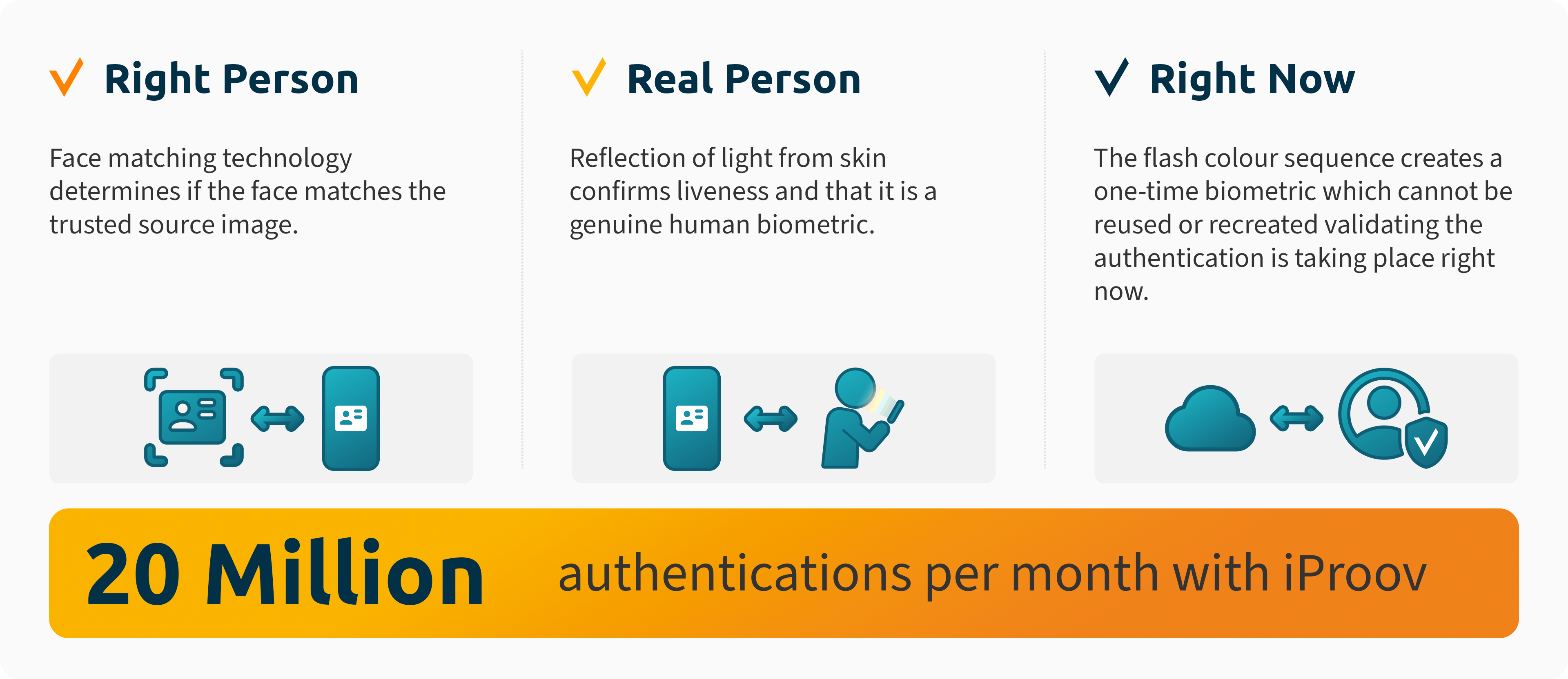
The highest level of assurance is recommended for KYC/AML because initial user onboarding is a high-risk action — you don’t know anything about the user or their risk until you have onboarded, so it’s important to start off securely, as trust established at onboarding will carry through the customer lifecycle. Our solution assures users are authenticating in real-time, and industry-first iSOC active threat management system enables response to new and emerging threats.
KYC and AML: Summary
- KYC is the requirement for financial organizations to obtain personal information about their customers to ensure that services are not misused.
- KYC is part of the larger AML framework, which refers to a set of regulations and techniques aiming to minimize money laundering.
- Financial institutions are spending billions of dollars annually to combat financial crime. These organizations face significant regulatory and reputational risks if they do not comply with KYC and AML.
- iProov supports KYC and AML compliance through two methods: customer verification during remote onboarding and ongoing authentication of returning customers. This means that you can be confident that your customers are who they say they are.
- Using high-assurance biometrics to assist with KYC and AML can cut costs, enhance and streamline regulatory compliance, reduce onboarding times, minimize frustrations, and delight customers.
- Remember that these points are dependent on the country and jurisdiction. Be sure to check your jurisdiction’s directive for more specific information.
KYC and AML regulations are no empty threat: global penalties for AML, KYC, sanctions, and customer due diligence failures reached $4.6 billion in 2024, with a single institution facing a $3 billion penalty for systemic AML failures. Organizations are under increasing scrutiny, and iProov can help.
Biometric verification can streamline KYC/AML processes while minimizing risks and ensuring regulatory compliance. Request a demo of our solution here.
KYC and AML: Frequently Asked Questions
- What is the difference between KYC and AML?
- KYC (Know Your Customer) is the process of verifying a customer’s identity, primarily at onboarding. AML (Anti-Money Laundering) is the broader framework of laws and controls to detect and prevent financial crime across the full customer lifecycle. KYC sits within AML – you cannot satisfy AML requirements without first having robust KYC controls in place.
- What does KYC and AML mean in banking?
- In banking, KYC means verifying a customer’s identity before opening an account or providing a financial product. AML refers to the legal obligations banks must meet to detect, report, and prevent money laundering and financial crime. Both are mandatory in most jurisdictions. In the US, compliance has been required since the USA Patriot Act came into force in 2001.
- What are KYC and AML checks?
- KYC checks verify a customer’s identity through three steps: collecting identifying information, verifying the authenticity of identity documents, and confirming that the person presenting the document is genuinely who they claim to be – typically using biometric liveness detection. AML checks run continuously and include sanctions screening, PEP monitoring, transaction analysis, and filing Suspicious Activity Reports (SARs) with authorities when required.
- What is KYC AML compliance?
- KYC AML compliance means an organization is meeting its legal obligations for customer identity verification (KYC) and financial crime prevention (AML). In practice this requires documented policies, trained staff, appropriate technology, and auditable records covering customer identification, risk classification, ongoing monitoring, and suspicious activity reporting. Regulators can, and do, assess compliance at any time.
- Why is KYC and AML compliance important?
- First and foremost because it is a legal requirement with serious financial and personal consequences for failure. Global penalties for AML, KYC, and CDD failings reached $4.6 billion in 2024 – and regulators are increasingly holding senior individuals personally liable, not just the institution. Beyond enforcement risk, weak KYC and AML controls directly enable fraud, money laundering, and terrorism financing.
- What is the KYC and AML process?
- The process begins at customer onboarding with identity verification and risk classification — Simplified Due Diligence (SDD), standard Customer Due Diligence (CDD), or Enhanced Due Diligence (EDD) depending on the customer’s assessed risk level. AML processes then run continuously: transaction monitoring, sanctions and PEP rescreening, adverse media checks, and periodic KYC refresh. The risk profile set at onboarding directly informs how monitoring thresholds are calibrated for each customer throughout the relationship.
- Who needs to perform KYC and AML checks?
- Banks, payment service providers, cryptocurrency exchanges, insurance companies, law firms and accountants handling financial transactions, and gaming operators above defined thresholds are all required to perform KYC and AML checks. The scope of obliged entities has expanded considerably in recent years, particularly for digital asset businesses following updated FATF guidance on virtual assets.
- What documents are required for KYC?
- At minimum, KYC requires a government-issued photo ID (passport, national ID card, or driving licence) and proof of address (utility bill or bank statement). For business customers, beneficial ownership information and corporate registration documents are also required. Exact requirements vary by jurisdiction and by the risk classification of the product or service being accessed.
- What is Enhanced Due Diligence (EDD)?
- Enhanced Due Diligence is a more intensive standard of scrutiny applied to high-risk customers — including Politically Exposed Persons (PEPs), customers from FATF-identified high-risk jurisdictions, and any individual whose activity or background raises concern. EDD goes beyond standard CDD to investigate source of funds and source of wealth in detail, requires more frequent monitoring, and typically needs senior management approval before the business relationship can proceed.